
A vessel’s speed target often attracts attention early in a project. Stability, loading and machinery decisions can seem like later engineering checks. In practice, the questions are connected: the hull, weight distribution, operating conditions and propulsion arrangement need to be developed together.
This does not mean every analysis must happen at once. It means each department should work from a coordinated set of assumptions and understand when another part of the design changes.
Start from the loading condition
Passengers, payload, fuel, fresh water, machinery and equipment all contribute to the vessel’s displacement and weight distribution. The vessel may operate in several loading conditions rather than one convenient design point. An early weight estimate should therefore be treated as a developing model, with an allowance for information that has not yet been finalized.
Placing equipment changes more than the arrangement drawing. Its weight and location can influence trim and the vessel’s centre of gravity. Those effects are relevant to both the stability assessment and the hydrodynamic condition used for performance analysis.
Describe the required performance clearly
A speed request should be paired with a loading condition and an intended operating profile. Ask whether the priority is a maximum speed, an economical cruising condition, towing capability or a combination of duties. Defining the mission helps the team choose the questions that analysis needs to answer.
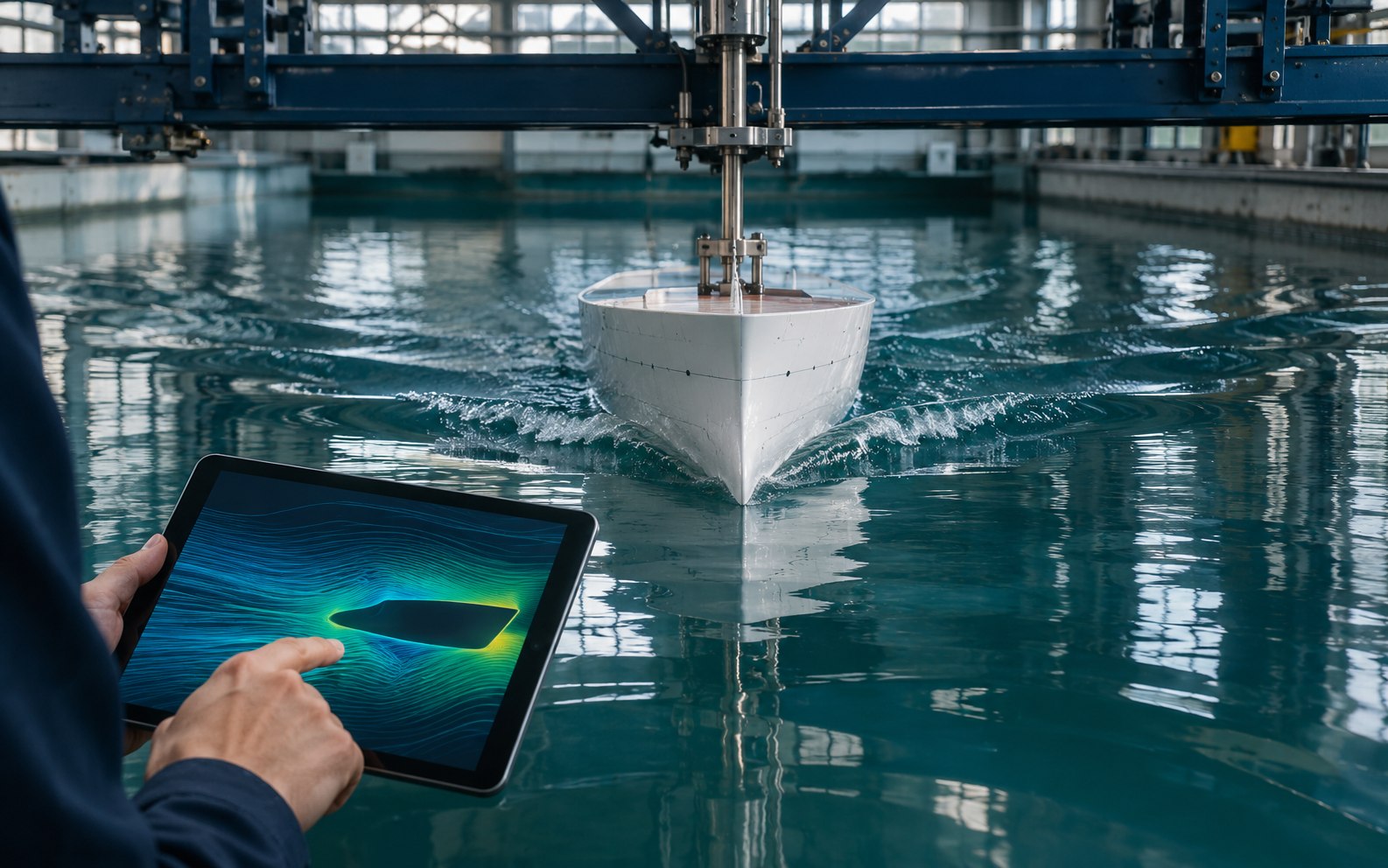
Resistance calculations and CFD can inform a powering estimate, but their value depends on the model, inputs and assumptions. They are not substitutes for a clear brief or a coordinated weight estimate. A polished flow image alone does not demonstrate that a performance target has been achieved.
Develop propulsion as a system
Engine selection involves more than matching a catalogue power figure to a resistance estimate. The team also needs to consider the propulsion arrangement, operating duty, machinery space, installation constraints and the information supplied by equipment manufacturers. Access for maintenance and the routing of supporting systems should be considered while the arrangement is still flexible.
This is where naval architecture, hydrodynamics and detailed systems engineering need a common basis. A late machinery change should trigger a review of affected drawings and assumptions, rather than being treated as an isolated equipment substitution.
Keep stability visible throughout design
Stability describes the vessel’s response to heeling and its ability to maintain or recover an acceptable attitude under the conditions being assessed. The applicable assessment depends on the vessel and its operation. The IMO identifies stability as a central part of ship design and safety; the appropriate requirements must be established for each project.
For an owner, the useful question is not simply whether a calculation exists. Ask which loading conditions it represents, what information remains provisional and which changes would require the assessment to be revisited.
Make interfaces between departments explicit
The concept team develops the overall arrangement. Naval architecture and hydrodynamics examine the hull and operating conditions. Structural design develops the supporting structure, while systems engineering coordinates equipment and services. Construction information then needs to reflect the agreed design rather than an earlier version.
A shared weight record, a clear drawing register and a documented set of analysis assumptions help these departments exchange information. They also give the builder a way to identify which version of the design is current.
Ask better questions at a design review
- Which loading condition supports the quoted performance target?
- What weight or equipment information is still provisional?
- Which assumptions are shared by the stability and resistance analyses?
- How will machinery or layout changes be communicated?
- Which analyses and drawings need to be updated before construction?
Coordinating these questions early does not remove iteration. It makes the reasons for each change visible and helps the project move toward a buildable, internally consistent design.
Further reading: IMO: ship design and stability.