
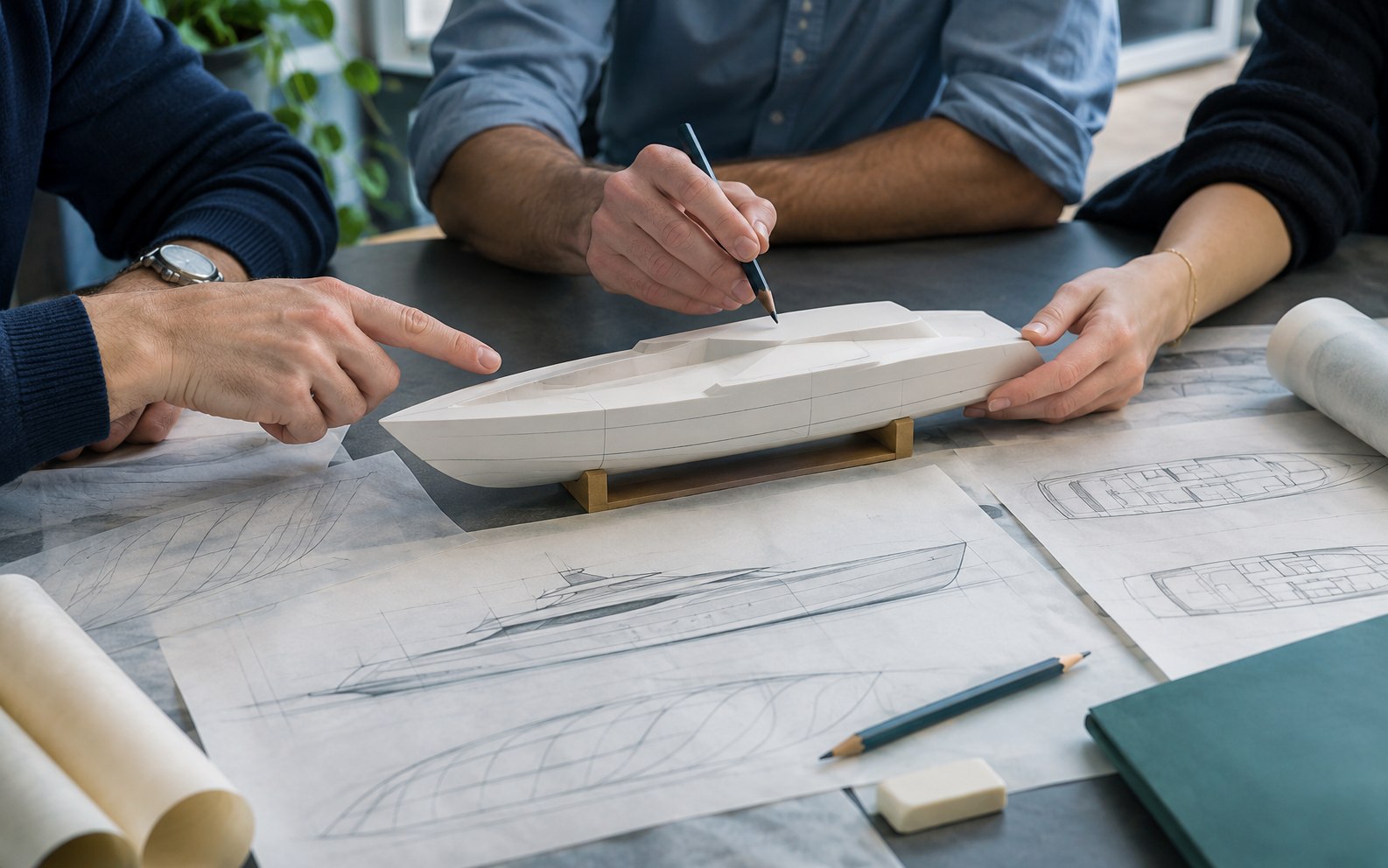
A useful vessel brief is not a collection of attractive reference images. It is an agreement about what the vessel needs to do, the conditions in which it will operate and the decisions that still need to be made. Getting those points onto paper early gives every department a clearer starting point.
The brief does not have to resolve every technical question. It should distinguish known requirements from preferences and assumptions. That distinction helps an owner and a design team explore options without treating an early guess as a fixed constraint.
Start with a working day
Describe a typical trip or operating cycle. Identify who is aboard, what they carry, where the vessel departs and how long it needs to remain away. A charter operator may care about boarding, passenger circulation and turnaround. A workboat operator may prioritize deck equipment, payload access and crew visibility. A private owner may have a different balance of accommodation and outdoor space.
Be specific about the activity rather than prescribing a solution too soon. “Two crew need to reach this equipment while underway” tells the designer more than a request to copy a deck layout from another boat.
Record the operating environment
List the intended waters, route, berth restrictions and any transport or storage limits. Include practical constraints such as access to a marina or a maximum available beam. State which limits are mandatory and which can be reviewed. The design team can then investigate the technical implications rather than discovering a decisive restriction after the layout has developed.
Separate targets from evidence
Speed, range and payload requests should identify the associated operating condition. A desired speed with a light vessel is a different brief from the same target with a full complement of passengers, fuel and equipment. Where information is not yet available, record the assumption and assign responsibility for confirming it.
Reference vessels can help explain a preference, but their appearance does not establish that their performance or construction method transfers to a new design. Keep photographs as visual context and use agreed requirements to guide engineering decisions.
Bring the builder into the conversation
If a yard has already been selected, ask about its construction methods, material preferences, production tools and drawing requirements. A design package that is clear to one builder may need additional detail for another. Establish how questions, revisions and approvals will be managed before production information is issued.
Agree what the next stage will deliver
A concept package may include hull development, a general arrangement and a 3D model. Later stages can add analysis, structural definition, systems coordination and construction drawings. Define the outputs for the immediate stage, who reviews them and which decisions they are intended to support. This is more useful than describing everything simply as “a complete design.”
Vessel design is an iterative process: a change in one requirement can affect several disciplines. SNAME’s educational boat-design guidance describes this connected process through a design spiral. A clear brief makes those iterations easier to discuss and document.
A short checklist to send your team
- The vessel’s purpose and a typical operating day.
- People, payload, equipment and endurance expectations.
- Operating area, berth and construction constraints.
- Performance targets with their assumed loading conditions.
- Available drawings, references and builder information.
- The deliverables and decisions needed for the next stage.
A good brief is a working document. Updating it as decisions are made keeps the owner, engineering departments and builder aligned.
Further reading: SNAME educational boat-design guidance.